The National Science Foundation funds Life Lab, from 1995-2001 in the Language Acquisition in Science Education at Rural Schools (LASERS) project. Life Lab starts working with 7 school districts to improve science teaching practices for second language learners. UCSC partners with Life Lab to evaluate student improvements in both academics and language acquisition.
Life Lab "borrows" teachers from districts to coach other teachers, lead science training classes and create a science and language summer school. The Summer School Academy Model of staff development shows a minimum of 6 months language gain by students attending the four week program!
LASERS Summer School Academy 1999 from Life Lab on Vimeo.
December 30, 1995


December 31, 1994
1994 ~ 4th-5th Grade Science Curriculum
Videodiscovery publishes 4th and 5th grade Life Lab Science Curriculum.
January 01, 1992
1992 ~ Life Lab Science Curriculum
 Videodiscovery publishes Kindergarten - Third grade science curriculum. This curriculum is disseminated throughout the country training 10s of thousands of educators.
<--Life Lab Science Laser Disc Cover
January 02, 1987
1987 ~ Great Expansion
Going Nationwide and Beyond
The United States Department of Education funds Life Lab to disseminate throughout the nation from 1987-1992! The project called the National Diffusion Network sends Life Lab Staff to 38 states Guam and Costa Rica.
National Science Foundation Funds LLS Curriculum
A NSF grant funds Life Lab Science K-3 Curriculuma, a core garden-based science curriculum.
Life Lab Moves to UCSC
Life Lab collaborates with the University of California Santa Cruz and the UCSC Farm and Garden and moves onto the 25 acre organic research and training center. Life Lab agrees to continue doing outreach to the community and to build a model educational garden on site.
The United States Department of Education funds Life Lab to disseminate throughout the nation from 1987-1992! The project called the National Diffusion Network sends Life Lab Staff to 38 states Guam and Costa Rica.
National Science Foundation Funds LLS Curriculum
A NSF grant funds Life Lab Science K-3 Curriculuma, a core garden-based science curriculum.
Life Lab Moves to UCSC
Life Lab collaborates with the University of California Santa Cruz and the UCSC Farm and Garden and moves onto the 25 acre organic research and training center. Life Lab agrees to continue doing outreach to the community and to build a model educational garden on site.
January 04, 1986
1986 ~ Life Lab Promotional Video
The following 14 minute video is a great summary of the impact that Life Lab Science Program has on schools. The power of school gardens has not changed much since 1986, but you will notice that hairstyles and clothing do!
Are you one of the people in this video? Add a comment to the post and tell us what you remember about Life Lab.
Life Lab 1986 from Life Lab on Vimeo.
Are you one of the people in this video? Add a comment to the post and tell us what you remember about Life Lab.
Life Lab 1986 from Life Lab on Vimeo.
January 03, 1986
1986 ~ The Growing Classroom Goes National
 Addison-Wesley and Life Lab enter into a publishing agreement. The Growing Classroom is promoted and sold across the country.
January 05, 1984
1984 ~ Statewide Dissemintation
The California Department of Education funds statewide dissemination of garden-based learning to 10 schools. Friends of the Harvest moves to the Santa Cruz County Office of Education and officially changes names to Life Lab Science Program.
March 06, 1982
1982 ~ The Growing Classroom: Garden-Based Science and Nutrition Curriculum

Life Lab self publishes the first version of The Growing Classroom Activity Guide and creates workshops which are conducted for 10 schools in Santa Cruz County. Life Lab garners its first science award, The WSTA Center of Excellence. Staff start attending regional and national conferences with The Growing Classroom Activity Guide.
January 07, 1979
1979 ~ Life Lab Becomes a Non-Profit
 Originally Life Lab was called Friends of the Harvest, a non-profit formed to support community programming. Around this time Gary Appel, co-founder of Life Lab was hired with Title IV C grant funding.
An excerpt from the oral history of Robbie Jaffe:
He [Gary] came out of an environmental education background. He had done a lot of work at outdoor ed camps, and had done some curriculum development. As soon as we interviewed him, I knew he was the perfect one. It was great ... We worked together as partners until he ended up moving to Michigan in the nineties. We developed at Green Acres School, and then ended up developing Life Lab into a national program, its own nonprofit organization. Gary was key in that.
January 08, 1978
1978 ~ Green Acres School - Life Lab Blossoms

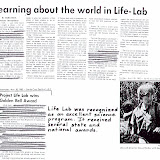 |
| Early days at Green Acres |
Green Acres in 1978 and 1982
Life Lab project started at Green Acres School in Live Oak, California in 1978. Life Lab teachers transform a vacant lot into a thriving garden. They start developing curriculum based on the idea that children are motivated to learn scientific ideas by asking questions while in the garden.
An excerpt from the oral history of Robbie Jaffe, co-founder of Life Lab Science Program, recalling how Life Lab blossomed:
Government agencies could get funding to hire people who met certain qualifications, and they’d be paid through this training program to do certain projects. Well, Live Oak School District, which is in an unincorporated area, had a wonderful community schools director at the time by the name of Mark Seamark... Mark, with the support of the Live Oak School District board, created a project through Comprehensive Training and Employment Act (CETA) that got funded, called Project Blossom. It turned out that the Blossom staff was made up of, I think we had seven or eight people, seven women, and one token guy...It was a phenomenal group of creative energy, creative minds. We were funded, and we were based at Green Acres School in Live Oak... Some of us were working on school-based projects; some of us were working on community projects. It was pretty much a free-for-all. We could create whatever kind of projects we wanted, and we had that creative energy. We were probably all in our twenties, maybe some were in their early thirties, and it was a time to literally blossom, for us.
I got involved in a project creating solar greenhouses...We had some funding from PG& E [Pacific Gas and Electric] for the project, and I think the county government even kicked in some funding. We built the greenhouses on those folks’ homes. Then the principal at Green Acres School, George Buehring said to me, “Well, let’s do one here too,” and I, of course, said, “Oh sure!” We got the funding for that, and we built it adjacent to one of the classrooms, actually with Ruth Antolini who was my mentor teacher....
George said, “Great! You know how to garden, right? Let’s start a garden.” I said, “Sure!” He said, “Let’s do it right outside of my office.” So right next to his office we put in a fifteen feet by twenty foot garden. He invited me to a teacher’s meeting to invite the teachers to participate...George and I said, “Well, who wants to volunteer for it? Whoever wants to do it, I’ll be willing to work with your class.” Ruth, of course, was totally in there. Ruth has a farming background and was a totally experiential teacher. She loved it, and she helped shape what the program was and is. Four or five teachers participated. We had a great time! The combination of what I was getting from Rich Merrill (Cabrillo College Horticulture Instructor), and the whole idea of “This is science,” and understanding the interactions, and learning and living it, is what it was it was all about. The kids totally went that direction. We would follow the kids’ lead. They would develop questions, and we would say, “Let’s experiment. Let’s set it up. Let’s figure it out.” It was this phenomenal inquiry learning taking place at a time when science wasn’t taught at all in elementary schools, much less inquiry learning. It was very, very exciting. It was at that point very small-scale, but what would happen is the parents would start coming in and saying, “What’s going on? How come my kid is not involved? Why isn’t my kid’s class out here?” So there started to build up some momentum around it. In the meantime, (this was all still part of Project Blossom) Project Blossom had a grant writer on the staff, Erica [Lann] Clark. She’s now a storyteller in town. Erica and I worked to get some grant funding to expand this and to create a science and nutrition curriculum to go along with it. We got what was then called, Title IV C. It was part of the whole Elementary and Secondary Education Act, which is federal, which is now No Child Left Behind.
This was in ’79, and we got funding to develop a curriculum and establish a model program using a garden to teach science. That was the real start of Life Lab. George said to the staff, “Well, the first year of the program everyone’s required to participate, and then second year you could choose. But I want everyone to at least start off in it.” He gave us this whole [piece of land]— It was basically a dirt parking lot, an overflow parking lot for Little League, or whatever. All the topsoil had been totally removed. George gave it to us to transform...It was a phenomenal transition. It transformed everything, not only just that the gardens came and were absolutely beautiful, but the kids painted murals on the wall. The whole school took on a whole new energy.
Subscribe to:
Posts (Atom)